Google “New Cases” Search Study Regarding Coronavirus
 There’s a new conspiracy theory floating around social media about how you can do a Google search for any 2, 3 or 4 digit number, plus the words “new cases” and come up with a result regarding Coronavirus or “COVID-19” that matches that query with the same number you’ve randomly chosen. The theory roughly goes something like Google is a part of the Deep State and is manipulating results to show that nearly anything is now related to Coronavirus… that no matter what number you search there will be a match because Google is trying to inflate how severe the problem is.
I’ll be the first to raise my hand to showcase how flawed it is when Google’s algorithm is imperfect or manipulated like here, or here so please understand that I’m merely seeking to explain what’s happening – perfect or not. I have no dog in this fight. If you look at my social media feed you’ll find that I have not expressed any opinion about the medical information or statistics presented about Coronavirus, because I have no expertise in these fields. But now (*cracks knuckles) – NOW is my time to shine!

Why Can I Type Any 2, 3 or 4 Digit Number, Plus “New Cases” and Find Exact Results Regarding Coronavirus?
Here’s How
Google’s algorithm (secretive as it is) is made up of some elements that most experienced SEO people are familiar with: Relevancy, Timeliness and Authority (or credibility). These 3 elements are driving the results you see in Google search, here’s how:
Relevance
The reason you see articles and reports about any number of “new cases” of Coronavirus is primarily due to the high relevance of Coronavirus at this moment in time. Google updates their algorithm hundreds of times per year to adjust for relevancy to things that are happening in the world, or locally. They need to constantly capture what people are wanting to find, or what they’re intending to search for so people will continue to use Google. Often times their algorithm has to make an educated guess (we see this all the time with predictive search suggestions). It actually works a lot like the human brain.
Think about this: if you walk up to a random stranger right now and say a random number plus “new cases” like “87 new cases” their first question would NOT be “New cases of what?“, it would likely be “Where“? That is the assumption that Google’s algorithm is making. Google is assuming you already know “what” and now your trying to get more information about the 87 new cases.
Timeliness
Another element of Google’s algorithm is timeliness, based on their Caffeine update in 2010, meaning – is what you’re searching and what Google is delivering a result of something that is happening at this moment in time. For instance, right now if you were to type “87 new cases” and Google delivered a bunch of results from news stories about the SARS epidemic from the early 2000’s, you’d strongly question how current those results are. You might even question how accurate Google is at delivering timely results, thus potentially making you less likely to use Google in the future to find timely information.
Authority
The reason you’re seeing mostly news websites (or video reports) when you type something like a random number + new cases is because of the authority of the website that information is on. News websites often get links to their website from a wide variety of other websites, mostly because website owners (like myself) link to news websites as a credible source of information in articles or blogs that they’re writing. This raises the authority (or credibility) of a website in Google’s algorithm. So when a news website anywhere in the world writes a story about “87 new cases” that is A) relevant to what’s happening (Coronavirus), B) timely and C) authoritative that means there’s a high likelihood that this article will appear at the top of results when you’ve searched that query.
Here’s Why
‘But Doug, there’s no way there can ALWAYS be a result that matches the number I’ve chosen’. Yes, there is and you’re wrong… here’s why.
-
Statista estimates that as of 2019 there are somewhere around 1.7 Billion websites world wide, that’s 1,700,000,000 websites. I’ve seen some current estimates of nearly 2 billion.
-
Since every country globally has had Coronavirus cases, every news outlet and many bloggers around the world have had some content on their website about the most recent number of cases. It’s a long established tactic in SEO to include numbers in the Title Tag (or Headline) of an article because Users often click through at a higher rate when they see numbers in search results, here’s a Quora Q&A to explain. That’s hundreds of thousands of websites (probably millions of websites) around the world reporting on the numbers of new cases near them. They’re all bound to have different numbers, not yet achieving 5 digits.
-
The primary news stories since February have been in regards to Coronavirus. The only topic that has interrupted this was the George Floyd protests. Coincidentally, if you simply type “was looted” into a Google search you’re likely to see a news story about a store that was looted due the most recent protests… not stories from stores that were looted from the Rodney King riots in Los Angeles from the 90s (that’s because there’s no timeliness connection to what’s happening today).
-
We’re now in a situation that news websites and blogs are publishing content every time there’s an update to Coronavirus cases, and Google delivers high authority websites with timely & relevant information. Voilà.
If the premise is that you can type any number from 1 to 4 digits into a Google search plus “new cases” and arrive at an exact number match (or near match) article regarding COVID-19 because Google is manipulating, the reality is because there’s only 9,999 available inputs & variations using this 1 – 4 digit rule. Out of 1,700,000,000 websites and given the information above it would be a statistical impossibility for you NOT to see every numeric variation have a match at the top of results or a “near match” regarding Coronavirus.
Google Trends
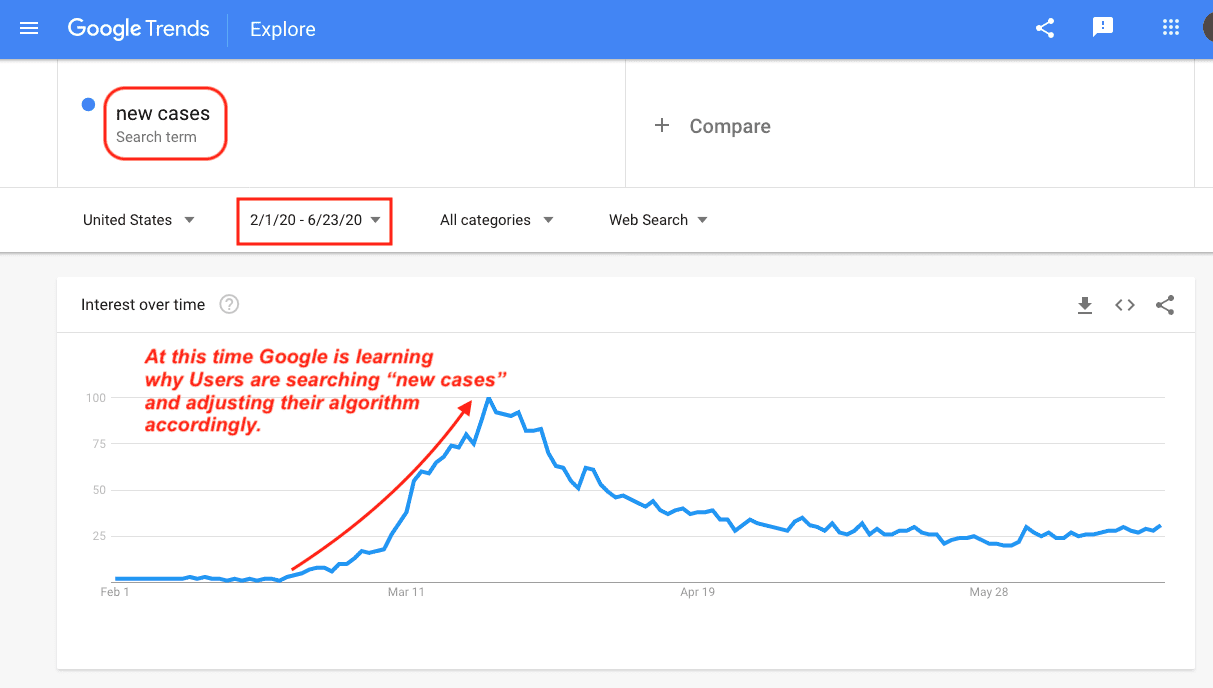
If you go to Google Trends and type the words “new cases” you’ll see that Google Users started to heavily search using this phrase in late February of 2020, prior to that this search phrase was hardly used at all by comparison. This means that with those billions of searches driving up the volume for that phrase, Google was learning what people were looking for, what sites they clicked on, what sites they abandoned, how long they stayed on those websites, and what they searched after they visited those websites. This taught Google very quickly what most people are looking for when they use the “new cases” phrase – Coronavirus information.
The Proof is in The Algorithm
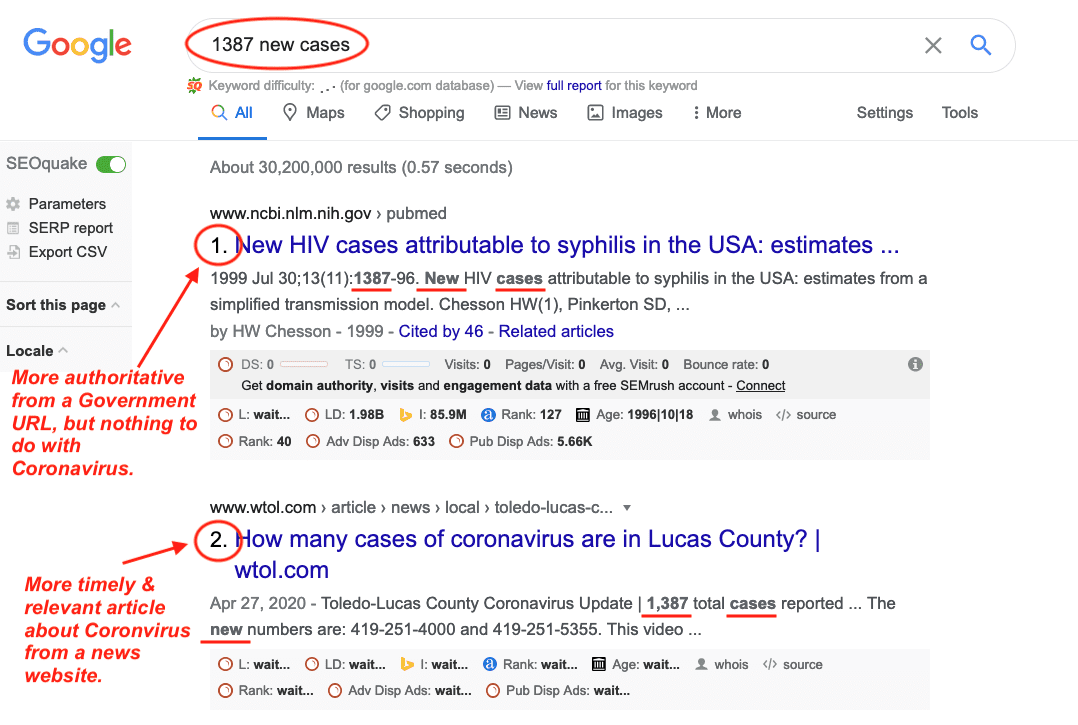
Take a look at the screenshot below where I’ve searched “1387 new cases” into a Google search. In this instance, Google has delivered the most authoritative website as the #1 result which is a Government (.Gov) website but has nothing to do with Coronavirus. The #2 result is an article from a far less authoritative news website that discusses Coronavirus cases. Bolded by Google, and underlined in red by me, you can see that both websites contain the words, “1387”, “new” and “cases” but neither has strung together “1387 new cases” as an actual phrase, so Google is defaulting to giving ranking preference to the website with more authority. In this example, if the WTOL.com website were to update the Title of the article and include a phrase “1387 new cases” within the content they would almost certainly overtake the #1 position because timeliness and relevancy would likely be more important than website authority. *Note: There’s also a chance that if this article gets some backlinks it might enter page 1 of results or even overtake the #1 position for the phrase “1387 new cases” because its an exact match phrase on an authoritative website discussing Coronavirus cases, and there might not be any other more authoritative websites discussing that exact number and context.
*Update June 24 – This Website is Now on Page 2 of Google for the Phrase “1387 new cases”
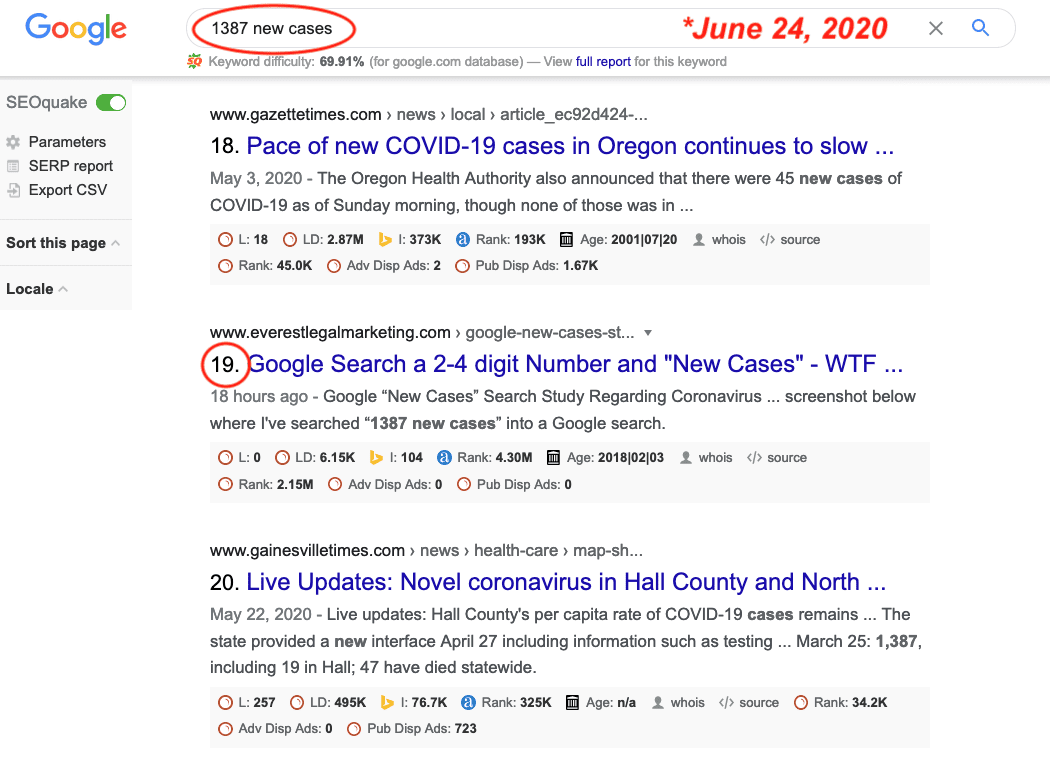
Less than 24 hours after the original publication of this article, this post has now made it’s way to page 2 of search results for the phrase “1387 new cases”. Am I surprised by this? No. Because that’s how Google’s algorithm works. Equally, I wouldn’t be surprised if this article either A) makes it to page 1 of results, or B) leaves the top 10 pages completely after Google learns that it’s not relevant for the intended search. Because that’s how Google’s algorithm works.
*Update June 25 – This Website is Now on Page 1 of Google for the Phrase “1387 new cases”
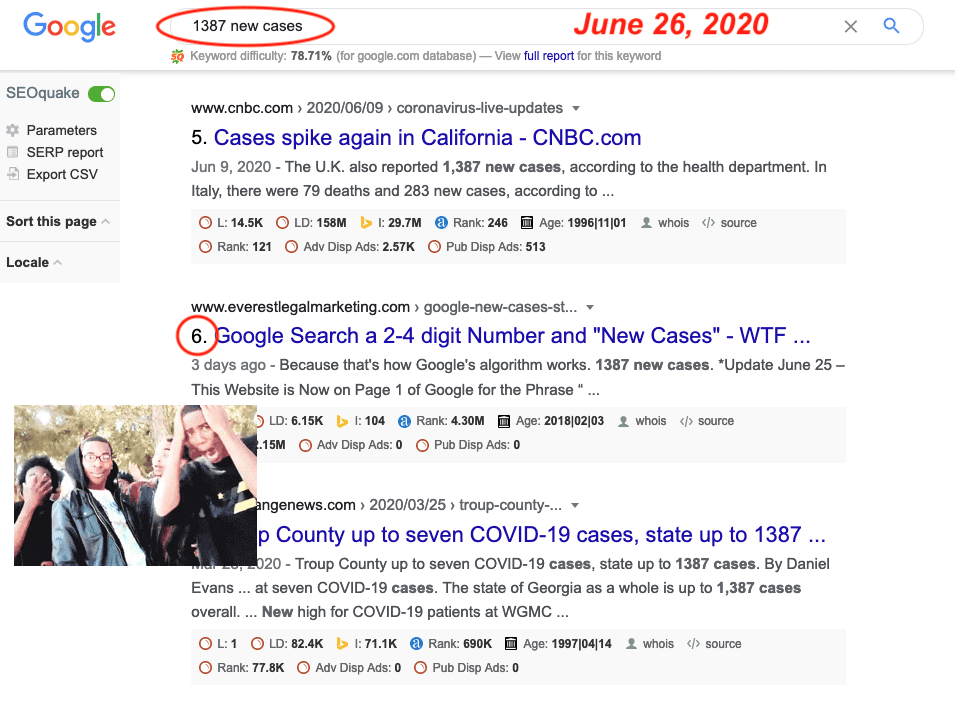
*Update June 26 – This Website is Now #6 on Page 1 of Google for the Phrase “1387 new cases”
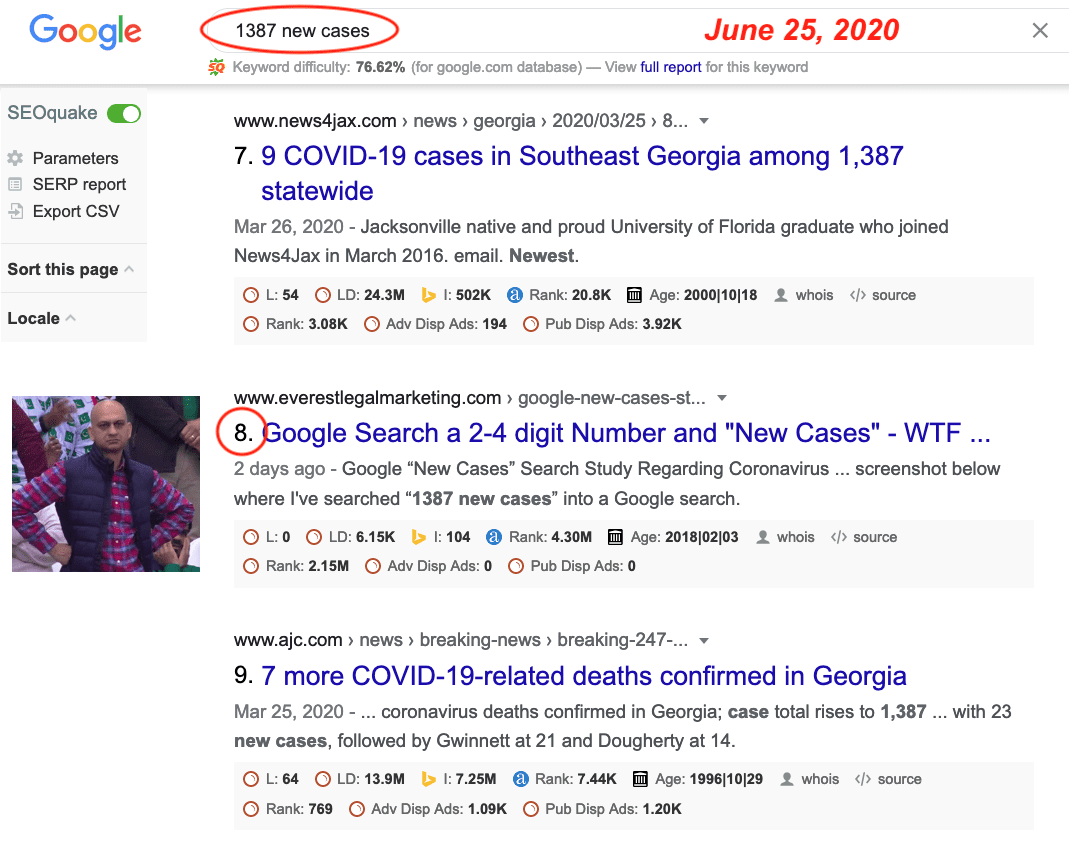
This will be my final update unless something out of the ordinary happens, but after 3 days this website made it to the middle of Page 1 of google results for the “1387 new cases” phrase (see screenshot below). What does that prove? Well to anyone who knows how search engine optimization works it’s absolutely nothing surprising, because there’s not 100 websites trying to rank on page 1 for that phrase. It’s the lack of relevant, timely & authoritative competition that makes it possible. As reader “Bernard” pointed out in the comments below:
“You keep mentioning ‘millions of websites’, as if there’s some huuuuuuuuuge pool of obscure sites out there build to generate traffic with random numbers of covid cases. That’s not the case. The results are pretty much uniformly very well known and established newspapers and magazines, along with local news websites from stations owned by the big 3. I would say that greatly reduces the likelihood that your explanation is going to stand up under examination.”
*See reply in comments section.
I hope Bernard is reading, because what this does prove is that an obscure website can get into page 1 of results, if it meets Relevancy, Timeliness and Authority. You can see below that this article is positioned right below CNBC.com at this moment in time and I am not a “big 3” network. To some, it might seem that given this information my website is as authoritative as CNBC, but that is also very wrong. All around the world there are far more authoritative websites than mine, who’s content is more relevant to news, health, medicine etc. and that’s why their websites are one page 1 for other searches.
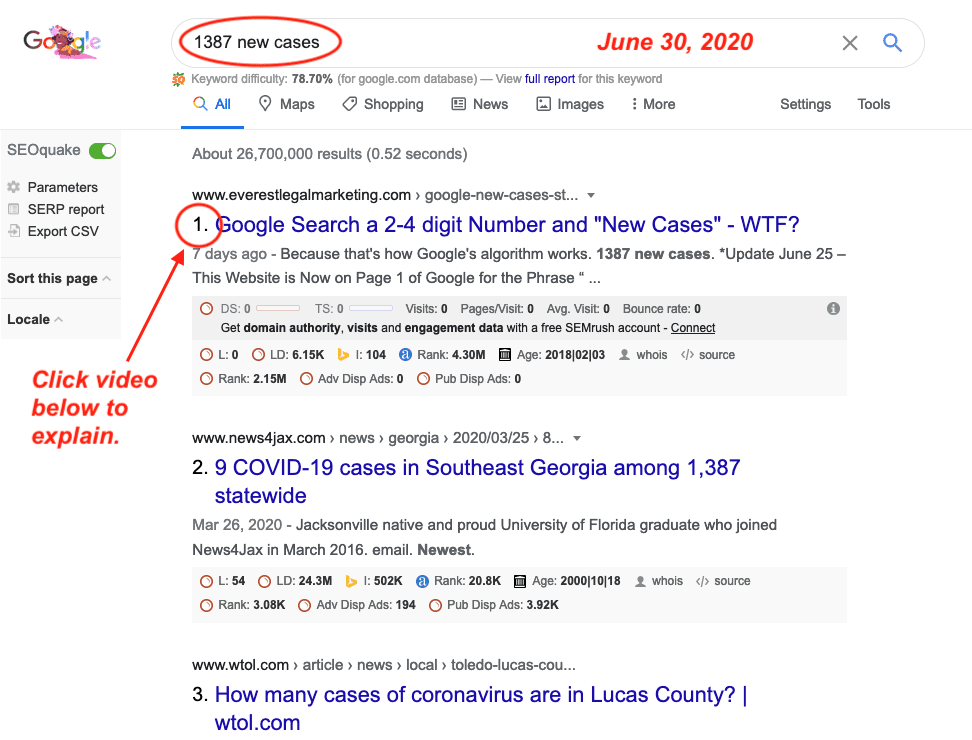
*Update June 30 – This Website is Now #1 for the Phrase “1387 new cases”
Am I now apart of the Deep State? Where do I get my Deep State compensation check?
Conclusion
Google’s algorithm is only strange if you don’t understand how it works. To the person who’s never seen electricity work, a light bulb might look like magic or deception. Even those of us who think we know how Google’s algorithm works sometimes get it wrong. The last thing Google wants a User to do is be disappointed in the search results and have to retype a phrase over and over again using variations to find what they want. If that were to happen constantly you might start using Bing (heaven forbid). That also means that if a new pandemic of another name were to suddenly take off you’d start to see results for those cases instead of Coronavirus.


President & Founder – Everest Legal Marketing, LLC
Doug Bradley is the Founder and CEO of Everest Legal Marketing. Doug has over a decade of experience specifically in legal marketing, and foremost with expertise in Search Engine Optimization for law firms. Doug has been quoted on numerous websites, co-hosted many MCLE sessions, and has advised law firms of all sizes on the topic of effective marketing and ethical SEO strategies.